



























Former MHA Official Claims Shoaib Akhtar and Mohammad Asif Brought Drugs During India Tours, Sparks Fresh Controversy
A sensational claim by former Union Home Ministry Under Secretary R.V.S. Mani has reignited controversy involving former Pakistan cricketers Shoaib Akhtar and Mohammad Asif. Speaking on a podcast, Mani alleged that the two players brought drugs into India during cricket tours, triggering widespread debate. The claims have not been independently verified, and neither Akhtar nor Asif has publicly responded so far.

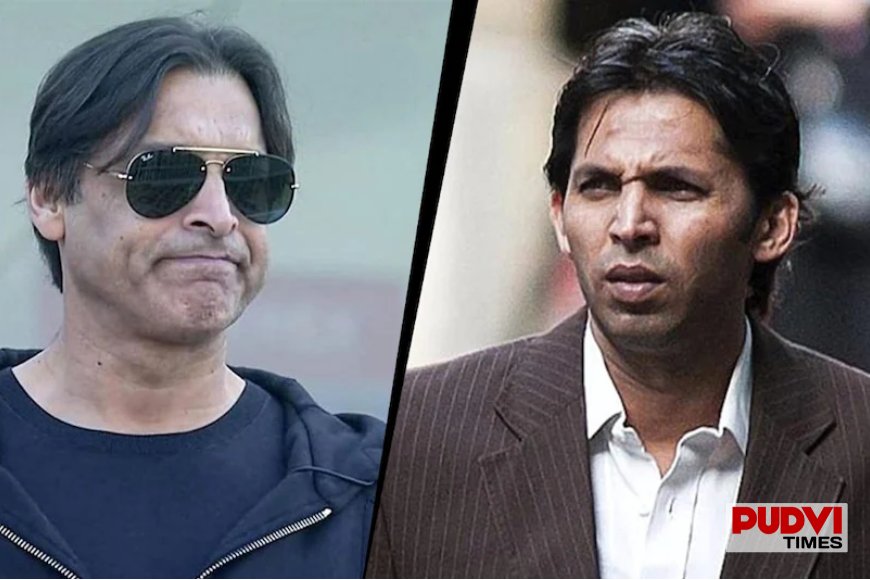
A fresh controversy has erupted in the cricketing world after former Union Home Ministry Under Secretary R.V.S. Mani made explosive allegations against former Pakistan fast bowlers Shoaib Akhtar and Mohammad Asif. During a recent podcast interview, Mani claimed that whenever the two cricketers visited India for international tours, they allegedly brought drugs with them. The remarks have generated widespread discussion across social media and sports circles, with many demanding evidence while others have called for a thorough examination of the claims.
According to Mani, the allegations stem from information he became aware of during his tenure in the Ministry of Home Affairs. He suggested that the matter was linked to intelligence inputs available at the time. However, he did not publicly present documentary evidence during the interview to substantiate the allegations. As of now, the claims remain unverified, and no official agency has released any fresh statement supporting them.
The timing of these remarks has attracted significant attention because India-Pakistan cricket has historically been associated with intense rivalry both on and off the field. Every revelation involving players from either country often attracts enormous public interest. Mani's comments have therefore revived discussions surrounding past controversies involving Pakistan cricket and its players.
Former Pakistan pacer Shoaib Akhtar, popularly known as the "Rawalpindi Express," enjoyed a celebrated international career and was regarded as one of the fastest bowlers in cricket history. Mohammad Asif, meanwhile, was widely admired for his exceptional swing bowling despite a career overshadowed by multiple controversies.
Both Akhtar and Asif have previously faced issues related to anti-doping regulations. In 2006, they tested positive for the banned performance-enhancing substance nandrolone during Pakistan Cricket Board testing. They were initially suspended before later being cleared on appeal by a PCB tribunal, although the episode remained one of the biggest controversies in Pakistan cricket. Those earlier anti-doping cases involved performance-enhancing substances and are separate from the new allegations made by R.V.S. Mani.
It is important to distinguish between established historical facts and the recent claims. The earlier doping controversy is documented in cricket records, whereas Mani's latest allegation regarding drugs being brought into India has not been independently verified. At the time of writing, neither Indian investigative agencies nor Pakistani authorities have announced any fresh inquiry related to the statements made in the podcast.
The former Home Ministry official also made several other claims during the same interview concerning Pakistan, intelligence operations, and cricket-related incidents from previous years. These broader remarks have further intensified public debate and media coverage. However, many experts have pointed out that such allegations require supporting evidence before any conclusions can be drawn.
The controversy has quickly spread across social media platforms, where users remain divided. Some believe the allegations deserve investigation considering Mani's former government position, while others argue that extraordinary claims require credible proof before they should be accepted. Several former cricketers and analysts have also advised caution, emphasizing that allegations alone should not be treated as established facts.
India and Pakistan have shared a complicated cricketing relationship for decades. Bilateral cricket series between the two nations have largely remained suspended due to political tensions, with both teams primarily meeting in ICC tournaments and multinational competitions. Because of this history, statements involving players from either country often receive enormous public attention.
Mohammad Asif's career itself has witnessed multiple controversies beyond the 2006 doping case. In 2010, he was among the Pakistani cricketers convicted in the infamous spot-fixing scandal involving the Lord's Test against England. That incident resulted in bans from international cricket and criminal convictions in the United Kingdom. Shoaib Akhtar, while involved in several disciplinary issues throughout his career, was never convicted in relation to that scandal.
Legal experts note that allegations involving criminal conduct require corroboration through documentary evidence, witness testimony, or official investigations before they can be considered proven. Without such evidence, the claims remain allegations made by an individual, regardless of the person's previous official position.
So far, neither Shoaib Akhtar nor Mohammad Asif has issued a public response addressing Mani's remarks. Similarly, the Pakistan Cricket Board has not released any statement regarding the allegations. If either player responds in the coming days, the controversy could take a new turn.
The incident also highlights how podcast interviews and digital platforms increasingly influence public discourse. Statements made during long-form interviews can quickly gain traction online, particularly when they involve high-profile personalities or sensitive India-Pakistan issues. Social media amplification often leads to widespread discussions before any official verification is available.
Observers believe that if credible evidence emerges supporting the allegations, investigative agencies may examine the matter further. Conversely, if no evidence is presented, the claims are likely to remain part of a broader public debate rather than an established legal finding.
For cricket fans, the controversy revives memories of previous scandals involving doping, disciplinary violations, and corruption that have affected international cricket over the past two decades. However, it also serves as a reminder that accusations should be separated from verified facts until supported by evidence.
As the story continues to develop, all eyes will remain on possible responses from Shoaib Akhtar, Mohammad Asif, the Pakistan Cricket Board, and Indian authorities. Until then, the statements made by former MHA official R.V.S. Mani remain unverified allegations that have reignited discussion around one of cricket's most politically sensitive rivalries.
What's Your Reaction?
 Like
0
Like
0
 Dislike
0
Dislike
0
 Love
0
Love
0
 Funny
0
Funny
0
 Angry
0
Angry
0
 Sad
0
Sad
0
 Wow
0
Wow
0