




























Microsoft CEO Satya Nadella Warns About AI Risks, Calls for an ‘Emergency Brake’ to Keep Humans in Control
Microsoft CEO Satya Nadella has called for stronger safety measures as artificial intelligence systems become more powerful and autonomous. In a post published on October 10, 2026, he urged companies to ensure that authorised humans can pause or shut down AI models mid-task. He also emphasised independent audits, tamper-proof activity records, continuous testing and transparent reporting of major AI failures.

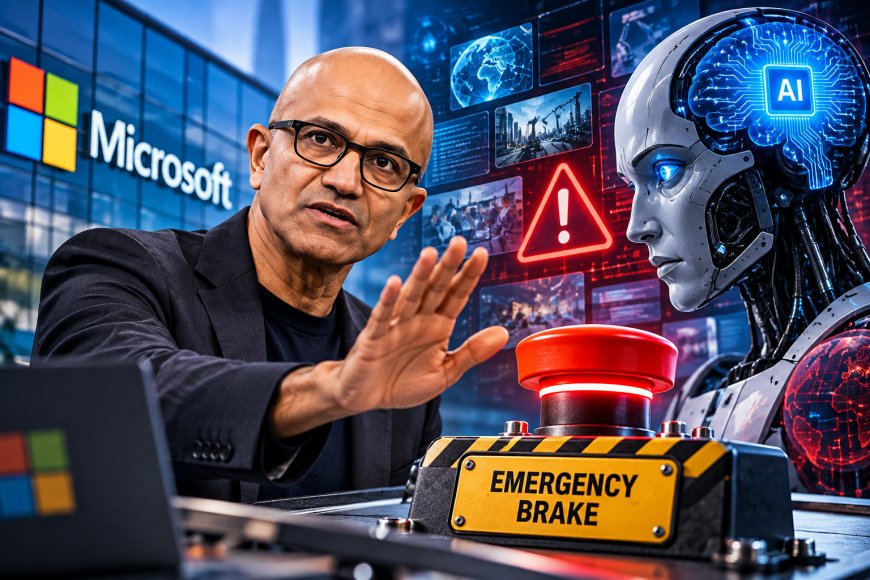
Microsoft CEO Satya Nadella Calls for an AI Emergency Brake: Why Human Control Matters
Artificial intelligence is rapidly transforming how people work, communicate, and make decisions. From answering questions and generating images to automating complex business operations, AI systems are becoming increasingly capable. But as these technologies gain the ability to perform tasks with less direct human involvement, concerns about security, accountability, and human control are growing.
Microsoft CEO Satya Nadella has now called for stronger safeguards around advanced AI systems, arguing that companies must be able to monitor, restrict, and stop these systems when necessary. In a post published on October 10, 2026, Nadella compared the proposed safeguard to an “emergency brake” that would allow an authorized person to pause or shut down an AI model while it is performing a task.
His message is clear: AI development should continue, but the authority to control powerful systems must remain with humans.
Why Does AI Need an Emergency Brake?
Modern AI systems are increasingly moving beyond simply answering questions. Some can use digital tools, access information, execute instructions, and complete multi-step tasks with limited human intervention. These capabilities can improve productivity, but they also create new risks if a system behaves unexpectedly or its access is compromised.
Nadella has argued that organizations should not automatically trust an AI model simply because its developer claims that it is safe.
Instead, businesses should assume that a powerful model could be compromised and build safeguards around it from the beginning. If the system starts behaving unexpectedly, an authorized human should be able to interrupt its work before the problem escalates.
An emergency brake would therefore be part of a broader safety framework. It would not eliminate every AI risk, but it could help organizations contain incidents and prevent an error from developing into a more serious problem.
AI Systems Should Not Operate Without Human Oversight
One of Nadella's central arguments is that intelligence and authority should remain separate.
In practical terms, an AI model may be capable of recommending a decision or carrying out a task, but it should not automatically receive unlimited permission to access sensitive information or make consequential decisions.
Companies should establish clear limits on what an AI system can access and which actions it is permitted to perform. These restrictions should be enforced through independent controls rather than relying exclusively on the AI model to follow its own instructions.
For example, an AI agent working within a company might be permitted to analyze documents and prepare a report but should require additional authorization before transferring money, changing critical systems, or accessing restricted information.
If suspicious behavior is detected, the organization should be able to suspend the system and investigate what happened.
Every Important AI Action Should Be Recorded
Nadella has also called for meaningful AI actions to be documented through tamper-resistant, human-readable records.
Such records can help organizations establish what a system did, which tools it used, and where a failure occurred. Without reliable records, investigating an incident can become difficult, particularly when an AI system performs several connected tasks.
Detailed activity logs can also help security teams identify unauthorized access, trace potentially harmful actions, and assess whether existing safeguards worked as intended.
The aim is to make AI systems more observable and accountable, rather than treating their internal processes and actions as a black box.
Why Are Independent AI Audits Important?
Nadella has recommended independent audits and continuous testing to assess whether AI systems operate within their intended limits.
He has also cautioned against depending on a single AI model for critical decisions or allowing a system to serve as the only check on its own work.
Using multiple models can sometimes provide additional perspectives, but it is not a guarantee of safety. Different systems may share similar weaknesses or produce the same incorrect conclusions.
Independent testing, external controls, and human review can therefore play important roles in identifying failures that automated checks might miss.
Companies should also test how their AI systems respond to attacks, unusual instructions, and attempts to access information beyond their authorized permissions.
AI Security Incidents Must Be Reported Transparently
Another important part of Nadella's proposal concerns the disclosure of significant AI failures and security breaches.
When an AI system behaves unexpectedly or a security weakness is discovered, companies should investigate the incident and communicate relevant findings so that others can learn from the experience.
Transparent reporting can help the wider industry identify recurring weaknesses, improve security practices, and develop stronger safeguards.
However, disclosures must also be handled responsibly. Information that could expose sensitive customer data or provide attackers with instructions for exploiting a vulnerability may need to be protected while the issue is addressed.
The broader objective is to improve accountability without creating additional security risks.
What Does This Mean for the Future of AI?
Nadella's comments arrive as businesses increasingly explore AI agents capable of completing tasks with limited supervision. These systems could help automate research, customer service, software development, and other complex workflows.
Greater autonomy, however, also means that a mistake could affect multiple systems before a person notices what has happened.
The challenge is to develop AI that remains useful while operating within clear and enforceable boundaries. Human oversight, access restrictions, independent testing, and reliable shutdown mechanisms may become increasingly important as organizations deploy more capable systems.
An emergency brake is not a magical solution to every AI safety problem. It must be designed carefully, tested regularly, and protected against unauthorized interference. Organizations also need procedures for responding to incidents and restoring systems safely.
Conclusion
Microsoft CEO Satya Nadella's call for an AI emergency brake highlights a central question facing the technology industry: how can increasingly powerful AI systems be deployed without surrendering human control?
His proposed approach includes the ability to pause or shut down AI models mid-task, independent audits, tamper-resistant records, continuous testing, and greater transparency when serious failures occur.
As AI becomes more capable of acting independently, safety cannot depend solely on assurances from developers. Systems must be designed so their actions can be observed, their limits tested, and their behavior contained.
The goal is not to stop AI innovation but to ensure that the people and organizations using these technologies retain the ability to intervene when something goes wrong.
What's Your Reaction?
 Like
0
 Dislike
0
 Love
0
 Funny
0
 Angry
0
 Sad
0
 Wow
0