
















Changing Global Trade Winds Help Propel India-EU Talks to the Finish Line
Evolving geopolitical realities and economic priorities pushed India and the European Union to bridge differences and move their long-stalled trade negotiations closer to completion.

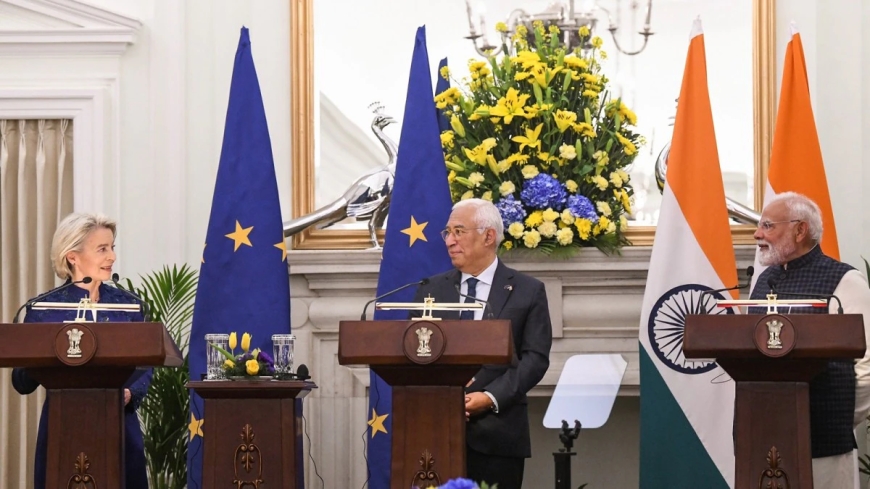
After years of slow progress and repeated pauses, India-EU trade negotiations gained fresh momentum as shifting global trade dynamics altered priorities on both sides. Rising geopolitical uncertainty, supply-chain disruptions, and the push to reduce over-dependence on single markets created a sense of urgency to conclude talks that had long remained stuck on sensitive issues.
For the European Union, diversifying trade partnerships beyond traditional hubs became critical amid tensions with major global economies. India, meanwhile, emerged as an increasingly attractive partner due to its large market, growing manufacturing base, and strategic importance in the Indo-Pacific. These factors encouraged greater flexibility, helping negotiators soften long-held positions on tariffs, market access, and regulatory standards.
India also recalibrated its approach, seeking stronger access for its services sector and skilled professionals while remaining cautious on areas such as agriculture and data protection. The EU, in turn, showed willingness to explore phased commitments and pragmatic solutions rather than all-or-nothing demands.
This convergence of economic needs and strategic considerations ultimately helped push negotiations across the finish line. The renewed agreement signals not just a trade breakthrough, but a broader alignment between India and the EU in an era where global trade is increasingly shaped by politics, resilience, and strategic trust rather than cost alone.
What's Your Reaction?
 Like
0
Like
0
 Dislike
0
Dislike
0
 Love
0
Love
0
 Funny
0
Funny
0
 Angry
0
Angry
0
 Sad
0
Sad
0
 Wow
0
Wow
0