




















Is China-India LAC Being Redrawn? What the ‘Early Harvest’ Plan Means for the Border
India and China have agreed on an eight-point framework to take forward talks on their disputed boundary after NSA Ajit Doval met Chinese Foreign Minister Wang Yi in Beijing. The focus on an “Early and Substantial Harvest” could mean progress on easier sections of the boundary before tackling the most complicated areas. However, no new LAC has been formally agreed upon yet.

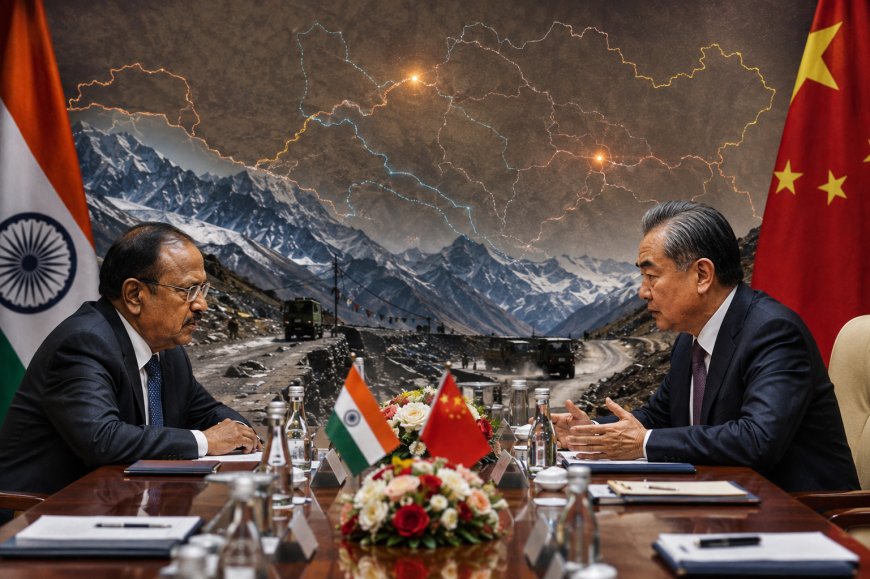
The India-China border dispute may be entering a new phase after a significant meeting between National Security Advisor Ajit Doval and Chinese Foreign Minister Wang Yi in Beijing.
The two sides held the 25th round of talks between the Special Representatives on the India-China boundary question. A day after the meeting, both countries outlined an eight-point understanding aimed at maintaining peace along the Line of Actual Control (LAC), improving border management, and taking forward discussions on boundary delimitation.
One phrase in particular has attracted attention—“Early and Substantial Harvest.”
But does this mean India and China are finally preparing to redraw or formally settle the LAC?
Not yet. The latest understanding should not be interpreted as a final agreement on a new border. Instead, it creates a framework for moving towards boundary delimitation through further negotiations.
What is the ‘Early and Substantial Harvest’?
The phrase essentially indicates an attempt to achieve early, concrete progress in areas where an agreement may be comparatively easier, rather than waiting for a complete settlement of the entire India-China boundary.
The two countries have reiterated their commitment to finding a fair, reasonable, and mutually acceptable solution to the boundary question, based on previously agreed political parameters and guiding principles.
This could allow negotiators to first focus on relatively less complicated portions of the boundary while leaving the most sensitive areas for later discussions.
Is the LAC actually being redrawn?
The key point is that the LAC has not been redrawn through this agreement.
The LAC is not the same as a mutually demarcated international boundary. India and China have historically held differing perceptions of where the LAC lies in several areas.
Boundary delimitation involves negotiating and agreeing on where the boundary should run. Demarcation is a later process of physically marking that agreed boundary on the ground.
The latest agreement therefore represents a move towards discussing these issues rather than an announcement that a new border has already been finalized.
New groups for boundary discussions
As part of the eight-point understanding, the two countries are expected to establish an Expert Group on Boundary Delimitation under the Working Mechanism for Consultation and Coordination.
A separate Working Group on Border Management will also be involved.
The groups will first work on their respective terms of reference and then take forward discussions on boundary-related issues and border management.
Two additional military hotlines
Another important part of the understanding is the decision to strengthen direct communication between the two militaries.
India and China have agreed to establish two additional border military hotline channels, including connections covering the Eastern and Middle Sectors.
Two additional meeting points for senior military commanders have also been agreed upon.
The objective is to ensure that tensions or misunderstandings along the LAC can be addressed quickly through direct communication.
Why does this matter after 2020?
Relations between India and China deteriorated sharply after the 2020 Galwan Valley clash, which resulted in casualties on both sides and triggered a prolonged military standoff.
Since then, diplomatic and military-level negotiations have continued to reduce tensions and stabilize the border situation.
The latest discussions suggest that both sides are attempting to move beyond crisis management towards a broader framework involving border management, communication mechanisms, and eventual boundary negotiations.
Trade and pilgrimage are also on the agenda.
The eight-point understanding extends beyond military and boundary issues.
India and China have also discussed improving border trade, pilgrimage, and people-to-people exchanges.
The reopening of designated border trade points and arrangements connected with the Kailash-Mansarovar pilgrimage are part of the broader effort to improve bilateral engagement.
What happens next?
The biggest test will be whether the new mechanisms produce actual progress on the ground.
If the Expert Group and Working Group can build consensus on certain sections of the boundary, the “Early and Substantial Harvest” approach could provide an incremental path towards resolving at least some long-standing differences.
However, the entire India-China boundary remains highly complicated, particularly in strategically sensitive sectors.
The next major milestone will be the 26th round of Special Representatives' talks, which is expected to be held in India in 2027.
Bottom Line
The latest India-China understanding does not mean that a new LAC has already been finalized.
Instead, Beijing has produced a potentially important diplomatic opening: both countries are preparing to push boundary negotiations forward, improve military communication, and seek early progress wherever possible.
In simple terms—no new border has been drawn yet, but India and China appear to be preparing a new roadmap for how parts of that border could eventually be settled.
What's Your Reaction?
 Like
0
Like
0
 Dislike
0
Dislike
0
 Love
0
Love
0
 Funny
0
Funny
0
 Angry
0
Angry
0
 Sad
0
Sad
0
 Wow
0
Wow
0