
























UPI MDR Charges Above ₹2,000: Customers Won’t Bear the Burden, Government to Monitor Transactions
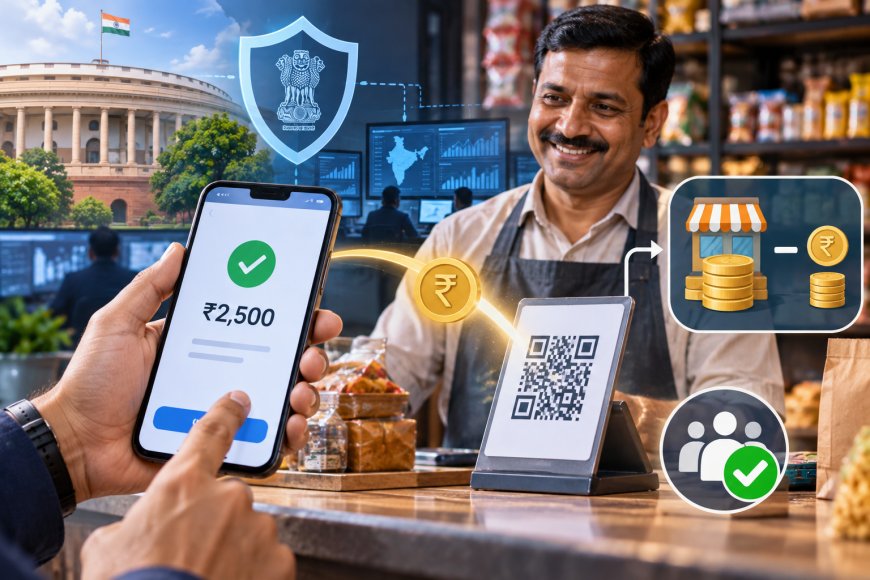
A new Merchant Discount Rate (MDR) framework for select UPI merchant payments above ₹2,000 is set to come into effect from October 15, 2026. The charge will apply to eligible Person-to-Merchant (P2M) transactions, but customers will not be directly charged. The government plans to work with payment aggregators to monitor the system and prevent merchants from passing the MDR burden on to customers.

New UPI MDR Rules From October 15
UPI users are set to see an important change in the digital payments ecosystem from October 15, 2026.
Under the new framework, a Merchant Discount Rate (MDR) will be applicable to select Person-to-Merchant (P2M) UPI transactions above ₹2,000.
The key point for consumers is that this is not a direct UPI transaction fee for customers. The MDR is a merchant-side charge within the payments ecosystem.
Will Customers Have to Pay More?
The government's stated approach is to ensure that customers do not end up paying the MDR separately when making UPI payments.
According to government sources cited in reports, discussions have already taken place with payment aggregators. The government plans to monitor implementation and take steps against practices where merchants attempt to recover MDR directly from customers.
So, for example, if a customer makes an eligible ₹5,000 purchase through UPI, the customer is not supposed to pay an additional UPI fee simply because the transaction exceeds ₹2,000.
Which UPI Payments Will Attract MDR?
The new framework primarily covers eligible P2M transactions above ₹2,000.
The standard MDR rate has been reported at 0.4%, subject to applicable transaction and merchant-category limits.
Importantly, this does not mean every UPI payment above ₹2,000 will automatically carry the same charge. Different merchant categories have different provisions.
What About Payments Below ₹2,000?
UPI merchant transactions of ₹2,000 or below will remain outside the new MDR framework.
Similarly, Person-to-Person (P2P) UPI transfers will continue to remain outside the merchant MDR system.
This means transferring money to a friend or family member is not the same as paying a merchant for goods or services.
Relief for Small Merchants
The framework also provides relief for smaller businesses.
Merchants receiving up to ₹1 lakh per month through UPI QR payments are classified under the small-merchant framework and receive relief from MDR under the applicable provisions.
This is intended to protect small retailers and micro-businesses that depend heavily on UPI payments.
Is There a Maximum MDR?
Yes. For eligible transactions, the MDR has a maximum cap of ₹300 per transaction.
For example, if the applicable MDR is 0.4%, a ₹50,000 eligible transaction would generate an MDR of ₹200. For a ₹1 lakh transaction, the percentage calculation would be ₹400, but the applicable cap would limit the MDR to ₹300.
Special Categories Have Different Charges
Not all sectors will follow the standard 0.4% MDR structure.
Certain categories—including railways, telecom, insurance, fuel and agricultural inputs—have special provisions. For eligible transactions above ₹2,000 in these categories, a flat MDR of ₹5 has been reported.
Certain utility, education and financial-service transactions can also have separate MDR structures under the framework.
Why Is MDR Being Introduced?
UPI has become one of India's most widely used digital payment systems. However, the zero-MDR model has created challenges around the long-term economics of operating and maintaining the payments infrastructure.
The new framework is intended to create a more sustainable commercial structure for parts of the UPI ecosystem while continuing to protect customers from direct payment charges.
The money generated through MDR can support the wider payments ecosystem, including payment processing and infrastructure.
Government to Keep an Eye on Merchants
One of the biggest concerns surrounding the new system is whether some merchants could attempt to add the MDR to customers' bills.
The government has indicated that it will work with payment aggregators and other stakeholders to monitor implementation.
The objective is to prevent practices where a merchant tells a customer to pay an additional amount simply because the customer chooses UPI.
What Changes for UPI Users?
For ordinary UPI users, the important points are:
- P2P UPI transfers remain outside MDR.
- Merchant payments up to ₹2,000 remain outside the new MDR framework.
- Select P2M payments above ₹2,000 will be subject to MDR.
- The standard reported MDR is 0.4%, subject to applicable rules and caps.
- The maximum MDR for eligible transactions is ₹300.
- Small merchants meeting the specified threshold receive relief.
- Customers are not supposed to be charged MDR separately.
- The government plans to monitor attempts to pass the cost directly to consumers.
The Bottom Line
The new UPI MDR framework does not mean that customers will suddenly have to pay a fee on every UPI transaction.
The major change concerns select merchant payments above ₹2,000, while P2P transfers and smaller merchant payments remain outside the new MDR structure.
The government's focus will now be on implementation and ensuring that merchants do not turn an ecosystem-level MDR into an additional charge for customers.
Note: MDR is a merchant-side payment processing charge and should not be confused with a direct UPI fee imposed on customers. The applicable rate can vary according to transaction type and merchant category.
What's Your Reaction?
 Like
0
 Dislike
0
 Love
0
 Funny
0
 Angry
0
 Sad
0
 Wow
0