



































Astronomers Discover "Super-Earth" Just 18 Light-Years Away in Habitable Zone
November 21, 2025 — Irvine, California – Astronomers at the University of California, Irvine, have unveiled an exciting discovery that could bring humanity one step closer to finding life beyond Earth. Their team, collaborating with international partners, has identified a rocky “super-Earth” orbiting within the habitable zone of its star — the region where temperatures may allow liquid water to exist.

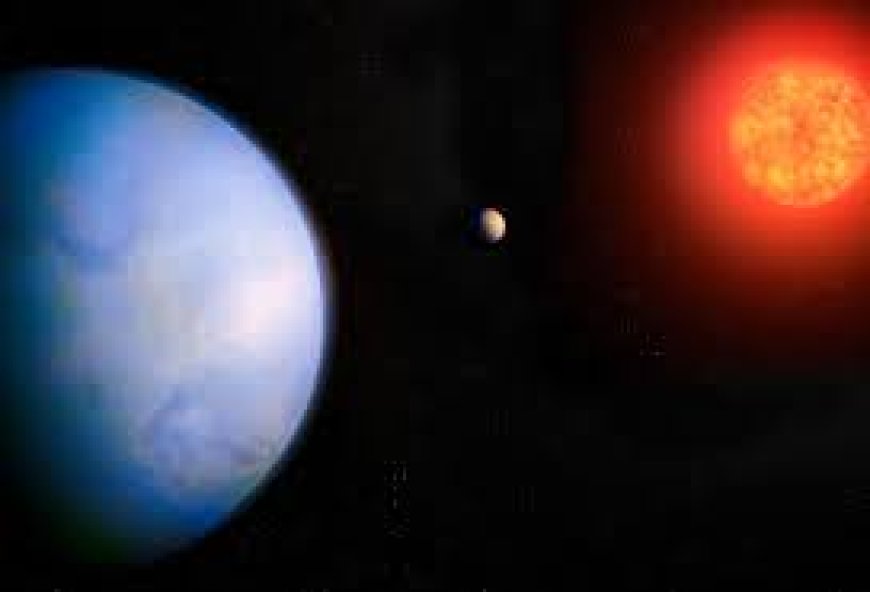
The planet, named GJ 251 c, is located just 18 light-years away, making it one of the closest known potentially habitable exoplanets. While it is similar in size to Earth, GJ 251 c is significantly more massive, earning it the classification of a super-Earth.
“Discovering exoplanets has become relatively common, but GJ 251 c is special because it is in our cosmic neighborhood,” said Paul Robertson, associate professor of physics and astronomy at UC Irvine.
A Rocky World Around a Common Star
GJ 251 c orbits an M-dwarf star, among the most common and ancient stars in the Milky Way. These stars are known for intense stellar activity, including flares and starspots, which can sometimes mimic planetary signals. Despite these challenges, the planet’s proximity to Earth makes it an excellent candidate for future direct imaging.
Lead author Corey Beard explained that the upcoming Thirty Meter Telescope (TMT) will have the ability to capture direct images of faint exoplanets like GJ 251 c, potentially confirming the presence of water — something smaller telescopes cannot achieve.
How It Was Discovered
The discovery relied on data from the Habitable-zone Planet Finder (HPF) and NEID instruments, which detect subtle shifts in a star’s light caused by gravitational interactions with orbiting planets. These tiny variations, known as radial velocity signatures, were key to identifying GJ 251 c.
HPF is particularly adept at studying M-dwarf stars because it observes in the infrared spectrum, where stellar activity is less disruptive. The research team believes their computational models robustly support GJ 251 c’s status as a true exoplanet, though final confirmation awaits future direct imaging.
Beard emphasized that while the current evidence is strong, next-generation telescopes and continued collaboration across the scientific community are essential to fully understand the planet’s characteristics.
“This discovery not only highlights the potential for life-supporting conditions close to Earth but also sets the stage for deeper exploration with upcoming technologies,” said Robertson.
The study detailing GJ 251 c has been published in The Astronomical Journal, marking a significant milestone in the ongoing search for habitable worlds beyond our solar system.
What's Your Reaction?
 Like
0
Like
0
 Dislike
0
Dislike
0
 Love
0
Love
0
 Funny
0
Funny
0
 Angry
0
Angry
0
 Sad
0
Sad
0
 Wow
0
Wow
0