




























Massive French Wildfire Sparks Lightning Storm, Threatens Areas Near Bordeaux
A massive wildfire in southwestern France has created its own lightning-producing storm system as flames continue to spread toward areas near Bordeaux. Authorities have evacuated thousands of residents, deployed hundreds of firefighters, and warned that strong winds and extreme heat could worsen the situation.

Massive French Wildfire Creates Lightning Storm as Flames Threaten Bordeaux Region
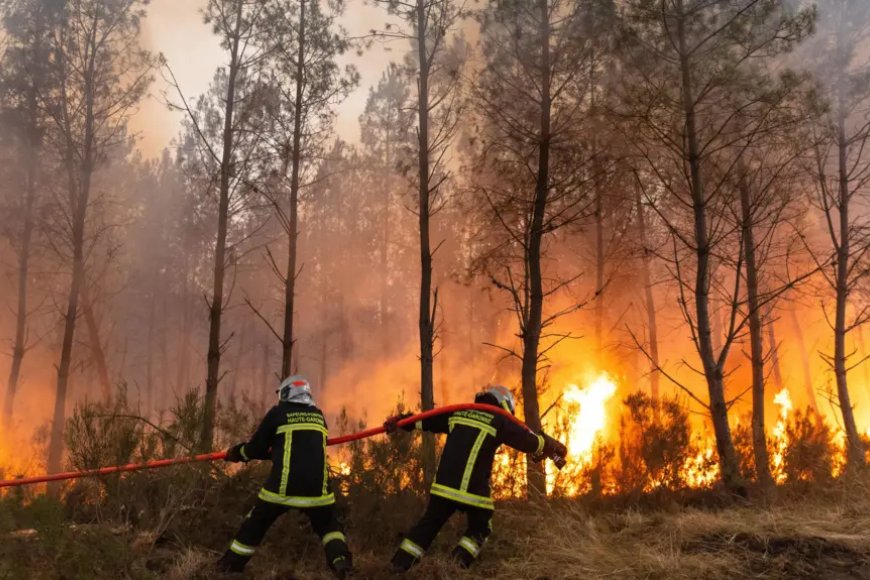
France is battling one of its most intense wildfire emergencies of the year after a massive blaze in the country's southwest generated its own lightning-producing storm, a rare weather phenomenon that has complicated firefighting efforts. The wildfire, burning through forests and dry vegetation near the city of Bordeaux, has forced large-scale evacuations, destroyed vast stretches of woodland, and raised fresh concerns about the growing impact of extreme weather events linked to climate change.
Firefighters have been working around the clock to contain the blaze, which has spread rapidly due to scorching temperatures, dry vegetation, and powerful winds. Authorities have deployed hundreds of firefighters, dozens of fire engines, water-dropping aircraft, and helicopters to stop the flames from reaching populated communities. Despite these efforts, officials warned that changing weather conditions continue to make the fire unpredictable, forcing emergency services to remain on high alert.
One of the most remarkable aspects of the wildfire has been the formation of a pyrocumulonimbus cloud, often described as a wildfire thunderstorm. These towering clouds form when the intense heat generated by a large fire causes hot air, smoke, ash, and moisture to rise rapidly into the atmosphere. As the cloud grows, it can create its own weather system, producing strong winds, lightning, and even localized rainfall. In this case, meteorologists reported that lightning generated by the fire itself posed an additional danger by increasing the risk of new fires starting in nearby forests.
Experts explain that pyrocumulonimbus storms are relatively rare but have become more common in recent years as larger and more intense wildfires occur across different parts of the world. The combination of prolonged drought, higher average temperatures, and increasingly dry forests creates ideal conditions for these extreme fire-driven weather systems. Once formed, the storm can further intensify the wildfire by producing erratic winds that rapidly change the direction and speed of the flames, making firefighting operations significantly more dangerous.
The wildfire has already burned thousands of hectares of forest, although officials continue to assess the full extent of the damage. Thick smoke has reduced visibility across several areas, affecting road traffic and air quality. Residents living near the affected regions have been advised to remain indoors where possible, keep windows closed, and follow evacuation instructions issued by local authorities. Several roads have been temporarily closed to allow emergency vehicles unrestricted access to the fire zone.
Authorities have evacuated thousands of residents from vulnerable communities as a precautionary measure. Emergency shelters have been established to accommodate displaced families, while local officials continue monitoring weather conditions that could influence the fire's behaviour. Firefighters remain focused on protecting residential neighbourhoods, critical infrastructure, and transportation routes leading toward Bordeaux.
The wildfire has also had a significant environmental impact. Large areas of woodland, wildlife habitats, and agricultural land have been damaged, with experts warning that ecological recovery could take many years. Forest ecosystems affected by intense fires often require decades to fully regenerate, particularly when repeated drought conditions slow natural recovery. Environmental scientists are also monitoring the release of carbon emissions from the blaze, as large wildfires contribute substantial amounts of greenhouse gases to the atmosphere.
Meteorologists note that southwestern France has experienced an extended period of unusually hot and dry weather, creating highly favourable conditions for wildfire outbreaks. Strong winds have further accelerated the spread of the flames, carrying burning embers over long distances and increasing the likelihood of spot fires igniting beyond existing containment lines. These weather conditions have made suppression efforts considerably more challenging despite the large-scale emergency response.
The incident has once again highlighted Europe's increasing vulnerability to extreme weather events. In recent years, countries including France, Spain, Portugal, Greece, and Italy have experienced increasingly severe wildfire seasons driven by prolonged heatwaves and drought. Climate researchers have repeatedly warned that rising global temperatures are increasing both the frequency and intensity of wildfire conditions across southern Europe.
French authorities continue to coordinate closely with national emergency agencies and neighbouring regions to ensure sufficient firefighting resources remain available. Additional personnel and specialised aircraft have been deployed as crews work to contain the fire before weather conditions deteriorate further. Officials have urged residents to avoid entering affected forest areas and to immediately report any signs of new fires.
Emergency management teams are also closely monitoring the possibility of further lightning generated by the wildfire's storm cloud. Unlike ordinary thunderstorms, lightning produced by pyrocumulonimbus clouds often occurs with little rainfall, increasing the risk that new fires may ignite instead of being extinguished. This phenomenon creates additional operational challenges for firefighters already battling the primary blaze.
As containment efforts continue, authorities have emphasised that public safety remains their highest priority. Residents are being encouraged to follow official evacuation orders, remain informed through government updates, and avoid spreading unverified information on social media. While firefighters have made progress in protecting key population centres, officials caution that the wildfire remains active and weather conditions could continue changing rapidly.
The wildfire near Bordeaux serves as another reminder of how increasingly extreme weather conditions are reshaping wildfire behaviour across Europe. The formation of a lightning-producing fire storm demonstrates the extraordinary power that large wildfires can generate under the right atmospheric conditions. As emergency services continue working to contain the blaze, scientists and policymakers alike are expected to study this event closely to better prepare for similar climate-driven disasters in the future.
What's Your Reaction?
 Like
0
Like
0
 Dislike
0
Dislike
0
 Love
0
Love
0
 Funny
0
Funny
0
 Angry
0
Angry
0
 Sad
0
Sad
0
 Wow
0
Wow
0