






























Nepal’s ‘Mad Honey’: The Dangerous Honey Harvested from the Edge of Death
Deep in the Himalayas, Nepal’s traditional honey hunters risk their lives to collect a rare type of honey known as ‘Mad Honey.’ Produced by bees feeding on certain rhododendron flowers, it can contain grayanotoxins, which may cause dizziness, vomiting, low blood pressure and a slowed heartbeat. In larger amounts, it can lead to serious poisoning.

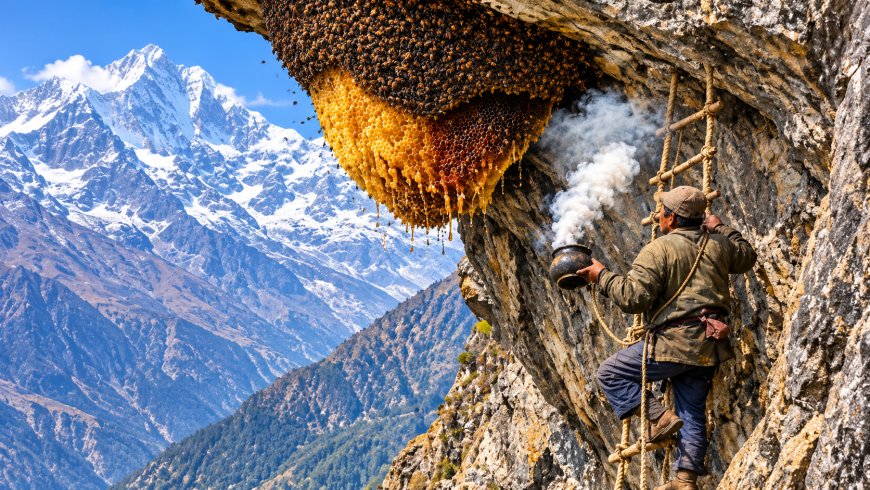
High in the Himalayan cliffs of Nepal, honey collection is far more than an ordinary harvesting job. Traditional honey hunters climb towering cliffs, often using ropes and handmade ladders, to reach enormous wild-bee colonies hanging hundreds of feet above the ground.
The honey they collect is known around the world as “Mad Honey”—a rare honey that can produce intoxicating and sometimes dangerous effects.
The honey is associated with the giant Himalayan honey bee, Apis laboriosa. These bees collect nectar from flowers of certain rhododendron species. The nectar can contain naturally occurring chemicals called grayanotoxins, which can make the resulting honey very different from ordinary honey.
Why is it called ‘Mad Honey’?
The name comes from the unusual effects that can occur after consuming it. Depending on the concentration of grayanotoxins and the amount consumed, people may experience dizziness, nausea, vomiting, weakness, blurred vision, sweating and a feeling of intoxication.
In some cases, blood pressure can drop significantly and the heart rate can become abnormally slow. Severe poisoning may require medical treatment.
This is why consuming Mad Honey simply for its intoxicating effects can be dangerous. The concentration of the toxin is not necessarily the same in every batch, making its effects difficult to predict.
Honey harvesting at the edge of cliffs
What makes the story even more dramatic is the way this honey is collected.
In parts of Nepal, traditional honey hunters climb steep Himalayan cliffs to reach wild bee colonies. They may descend using long ropes while smoke is used to drive bees away from the honeycombs.
The hunters then cut pieces of the enormous honeycombs and lower them toward the ground.
A single mistake can have devastating consequences because the honeycombs are often located on almost vertical rock faces, far above the ground.
For communities involved in traditional honey hunting, however, the practice represents much more than an extreme adventure. It is connected to livelihoods, local knowledge and cultural traditions passed down through generations.
The role of rhododendron flowers
Rhododendrons are particularly important in the story of Mad Honey.
Certain rhododendron species contain grayanotoxins. When bees collect nectar from these flowers, the compounds can make their way into the honey.
However, not every honey collected in Nepal is necessarily intoxicating or toxic. The concentration of grayanotoxins can vary depending on factors such as the flowers visited by the bees, the location and the harvesting season.
That means the effects of Mad Honey can differ significantly from one batch to another.
A rare Himalayan tradition under pressure
Traditional honey hunting is also facing environmental and economic challenges. Changes in the Himalayan environment, declining bee populations and changes in honey production have created concerns about the future of the practice.
For the communities that continue the tradition, protecting the bees and the surrounding ecosystem is therefore closely linked to protecting their own cultural heritage.
The story of Nepal’s Mad Honey combines extreme mountain survival, traditional knowledge and natural chemistry. But despite its reputation as a natural intoxicant, it is important to remember that the same substance responsible for its unusual effects can also cause serious poisoning.
What's Your Reaction?
 Like
0
 Dislike
0
 Love
0
 Funny
0
 Angry
0
 Sad
0
 Wow
0