


































Voyager 1: Humanity’s Eternal Emissary Reaches One Light-Day From Earth
Voyager 1 is set to become the first human-made object to reach one light-day from Earth in 2026. Explore the spacecraft’s extraordinary 47-year journey through Jupiter, Saturn, interstellar space, and its enduring legacy as humanity’s farthest and most iconic cosmic messenger

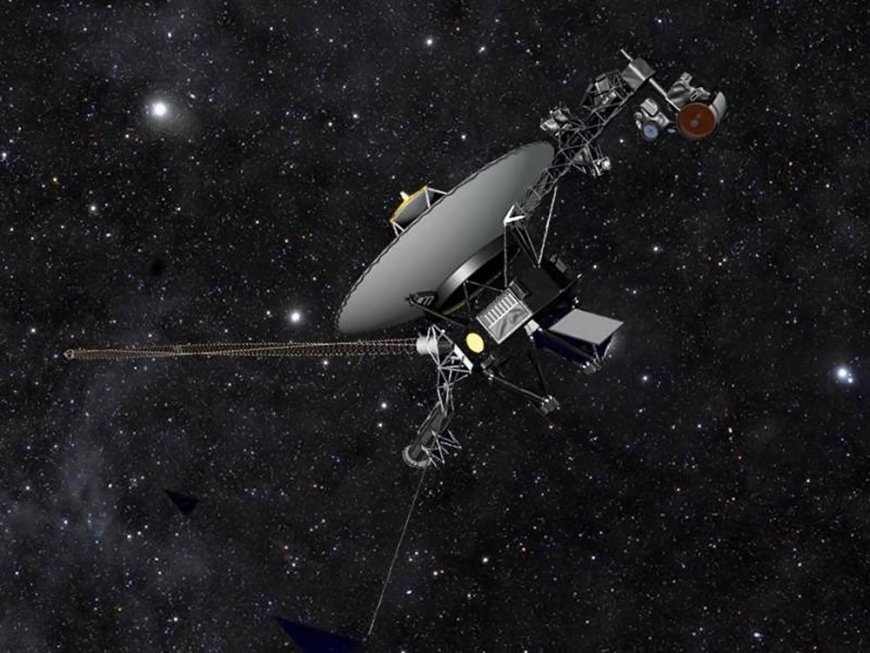
Nearly half a century after its launch, Voyager 1, Earth’s farthest and most enduring spacecraft, is poised to achieve a milestone of cosmic proportions: by November 2026, it will be exactly one light-day away from Earth—a staggering 25.9 billion kilometers (16 billion miles). This marks the first time any human-made object has reached such an extraordinary distance. The feat underscores humanity’s growing reach into the cosmos and the resilience of a spacecraft that has exceeded every expectation of its creators.
Launched on September 5, 1977, Voyager 1 was originally designed for a brief planetary mission to the outer solar system. Instead, through a blend of engineering brilliance, scientific ambition, and cosmic luck, it became the first spacecraft to enter interstellar space, now traveling through the darkness far beyond the planets.
A Milestone Written in Light
A light-day represents the distance light travels in 24 hours.
When Voyager 1 crosses that boundary in 2026, radio commands sent from Earth will take a full 24 hours to reach the spacecraft—and a reply would take another 24 hours to come back. Every exchange between Voyager and Earth will require two days, showcasing the mind-bending scale of space.
NASA engineers describe this milestone as both humbling and awe-inspiring. As project manager Suzy Dodd stated, Voyager reminds us "how far humanity has pushed into the unknown."
The Remarkable Journey of Voyager 1
1979 – Jupiter Encounter
Voyager 1 provided the first detailed look inside Jupiter’s Great Red Spot, discovered active volcanoes, and observed Jupiter’s delicate ring system.
1980 – Saturn and Titan Flyby
The probe delivered groundbreaking data on Saturn’s atmosphere and rings and captured key observations of Titan, revealing the thick, hazy atmosphere that would later inspire future missions.
2012 – First Human-Made Object in Interstellar Space
Voyager 1 crossed the heliopause, the boundary where the Sun’s influence fades and the galaxy’s begins. Here, it encountered a new realm of plasma, cosmic rays, and magnetic fields—its instruments still measuring this alien environment.
Still Whispering From the Stars
Despite nearly 50 years of travel and dwindling power, Voyager 1 continues to send scientific data. Each transmission travels for over 22 hours before reaching Earth. NASA has prolonged its life by shutting down nonessential systems and carefully managing its nuclear power source. Some instruments are expected to remain active into the early 2030s, after which Voyager will continue its silent drift through the galaxy.
The Golden Record: Earth’s Message Across Eternity
Affixed to Voyager’s side is the Golden Record, a gold-plated disc containing:
-
116 images of Earth
-
Sounds of rain, wind, waves, and animals
-
Greetings in 55 languages
-
Music from around the globe
This time capsule represents humanity’s hope that one day, someone—or something—might find our cosmic message.
Toward the Infinite Future
After reaching one light-day away in 2026, Voyager will continue outward toward the distant Oort Cloud, which it will not reach for roughly 300 centuries. Its ultimate destination is unknown; its journey is endless.
While the spacecraft may fall silent within a decade, Voyager 1 will continue traveling for billions of years, long after Earth, the Sun, and even human civilization have transformed. It will forever remain our most distant messenger—a tiny, silent witness carrying the story of our world to the universe.
What's Your Reaction?
 Like
0
Like
0
 Dislike
0
Dislike
0
 Love
0
Love
0
 Funny
0
Funny
0
 Angry
0
Angry
0
 Sad
0
Sad
0
 Wow
0
Wow
0