


























Chinese Coast Guard Fires Water Cannon at Philippine Vessel Carrying CNN Crew Near Disputed Shoal
A Chinese Coast Guard vessel allegedly used a water cannon against a Philippine government ship carrying a CNN news crew near the disputed Scarborough Shoal in the South China Sea. The latest confrontation has once again highlighted growing tensions between Beijing and Manila over contested maritime territories.

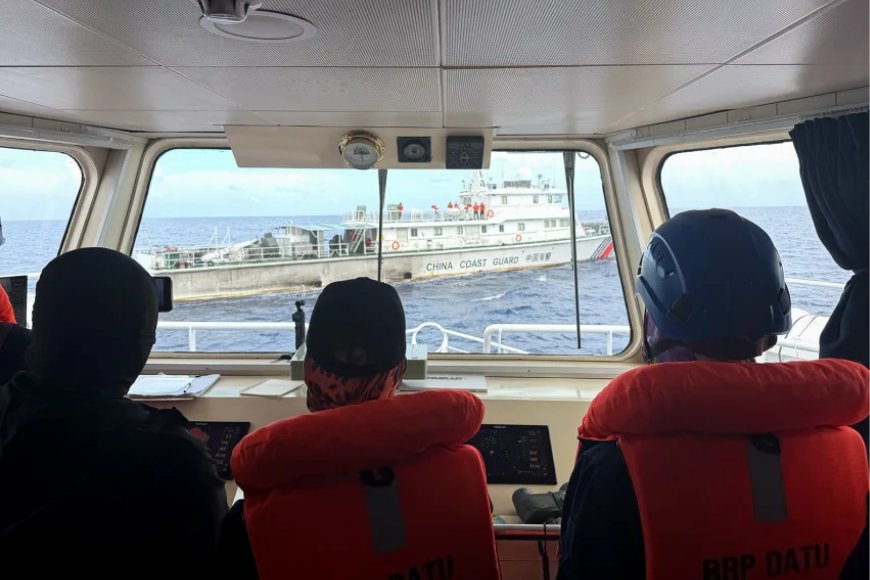
Tensions in the South China Sea have escalated once again after a Chinese Coast Guard vessel allegedly fired a powerful water cannon at a Philippine government ship carrying a CNN news crew near the disputed Scarborough Shoal. The incident, which was captured by journalists on board, has drawn international attention to the ongoing maritime dispute between China and the Philippines, raising fresh concerns over freedom of navigation and regional security.
According to Philippine authorities, the vessel was conducting a routine maritime mission in waters claimed by the Philippines when it was intercepted by Chinese Coast Guard ships. Officials alleged that one of the Chinese vessels used a high-pressure water cannon against the Philippine ship in an attempt to force it away from the disputed area. Video footage recorded by the CNN crew reportedly showed powerful jets of water striking the vessel, causing temporary disruption to its mission. No serious injuries were immediately reported, although the crew described the encounter as dangerous.
The incident occurred near Scarborough Shoal, one of the most contested maritime features in the South China Sea. The shoal has been at the centre of a long-running territorial dispute between China and the Philippines. While the Philippines considers the area part of its Exclusive Economic Zone (EEZ) under the United Nations Convention on the Law of the Sea (UNCLOS), China claims sovereignty over almost the entire South China Sea through its controversial "nine-dash line" claim. This overlapping claim has led to repeated confrontations between the two countries in recent years.
Philippine officials strongly condemned the latest incident, describing the use of water cannons as dangerous and irresponsible. They argued that such actions threaten the safety of civilian crews, journalists and government personnel operating in internationally recognised waters. Manila reiterated its commitment to defending its maritime rights while calling on China to respect international law and avoid actions that could further escalate tensions in the region.
China, however, has consistently maintained that its Coast Guard operates lawfully within what it considers its territorial waters. Chinese authorities have frequently accused Philippine vessels of entering areas under Chinese jurisdiction without permission and have defended the use of water cannons and other enforcement measures as necessary to protect China's maritime sovereignty. Beijing has not publicly acknowledged any wrongdoing in previous similar incidents and continues to reject the 2016 international arbitration ruling that invalidated many of its South China Sea claims.
The presence of a CNN news crew aboard the Philippine vessel has given the latest confrontation significant international visibility. Footage recorded during the incident has provided a rare first-hand account of the increasingly tense encounters taking place in one of the world's busiest and most strategically important waterways. International media coverage has intensified scrutiny of the actions of both countries and renewed debate over maritime security in the Indo-Pacific region.
The South China Sea remains one of the world's most sensitive geopolitical hotspots. In addition to China and the Philippines, several other countries, including Vietnam, Malaysia, Brunei and Taiwan, have competing territorial claims in different parts of the sea. The region is of enormous strategic importance because it serves as a major global shipping route through which trillions of dollars' worth of international trade passes each year. It is also believed to contain substantial reserves of oil, natural gas and rich fishing grounds.
The latest confrontation is part of a broader pattern of maritime incidents that have increased over the past few years. Philippine supply missions, Coast Guard patrols and fisheries operations have repeatedly encountered Chinese vessels near disputed reefs and shoals. Several previous incidents have involved water cannons, dangerous manoeuvres and close encounters at sea, prompting diplomatic protests from Manila and expressions of concern from the United States and other allies.
The United States has repeatedly reaffirmed that its Mutual Defense Treaty with the Philippines applies to armed attacks on Philippine public vessels in the Pacific, including those operating in the South China Sea. Although incidents involving water cannons have not triggered military responses, Washington has consistently called for respect for international law, freedom of navigation and the peaceful resolution of disputes. Other regional partners, including Japan, Australia and the European Union, have also expressed concern over rising tensions in the area.
Security analysts warn that repeated confrontations between Chinese and Philippine vessels increase the risk of accidental escalation. While neither side appears to be seeking direct military conflict, close encounters at sea carry the potential for miscalculation, particularly as patrols by both countries become more frequent. Experts argue that stronger communication mechanisms and diplomatic engagement are essential to preventing future incidents from spiralling into a larger regional crisis.
As both Beijing and Manila continue to defend their respective claims, the South China Sea remains a focal point of international diplomacy and strategic competition. The latest water cannon incident, witnessed by an international media crew, has once again underscored the fragile security situation in the region. With competing territorial claims showing no sign of resolution, maritime confrontations are likely to remain a significant challenge for regional stability and international relations in the months ahead.
What's Your Reaction?
 Like
0
Like
0
 Dislike
0
Dislike
0
 Love
0
Love
0
 Funny
0
Funny
0
 Angry
0
Angry
0
 Sad
0
Sad
0
 Wow
0
Wow
0