













Sonam Wangchuk Visits Rajghat After Hospital Discharge, Says Dharmendra Pradhan's Resignation Is Just the Beginning
Social activist Sonam Wangchuk visited Rajghat shortly after being discharged from the hospital, ending weeks of uncertainty following his prolonged hunger strike. Paying tribute to Mahatma Gandhi, Wangchuk said that former Education Minister Dharmendra Pradhan's resignation is only the first step and expressed hope that the government would now implement systemic reforms to ensure transparency and accountability in India's education system.

Sonam Wangchuk Visits Rajghat After Hospital Discharge, Says Dharmendra Pradhan's Resignation Is Only the Beginning of Education Reforms
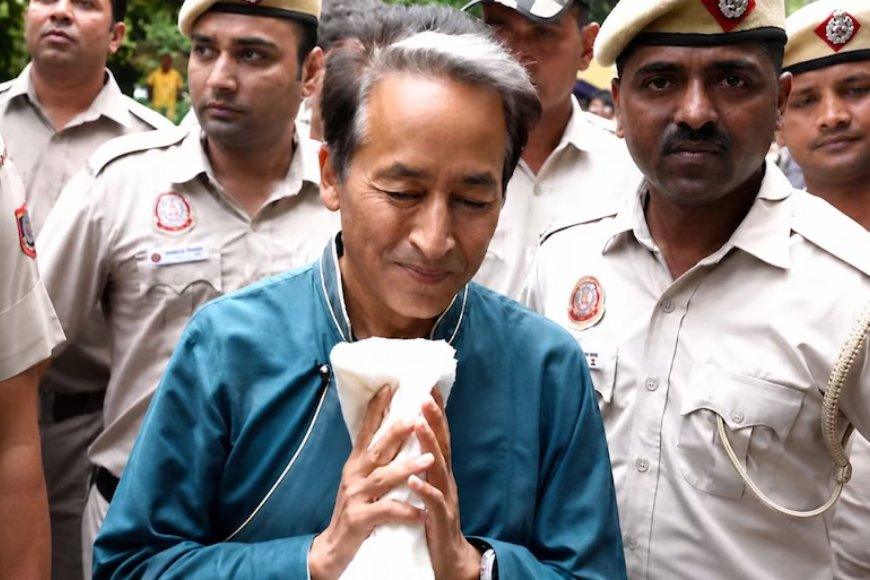
Social activist and education reform advocate Sonam Wangchuk on Monday visited Rajghat in New Delhi soon after being discharged from the hospital, marking an emotional return to public life following his prolonged fast demanding accountability over the NEET-UG 2026 paper leak controversy. The visit came just days after his hunger strike concluded and former Union Education Minister Dharmendra Pradhan stepped down from his post. Standing at the memorial of Mahatma Gandhi, Wangchuk reiterated that the resignation of a minister should not be viewed as the final objective of the movement. Instead, he described it as "only a beginning", expressing hope that the government would now move towards comprehensive institutional reforms capable of preventing future examination scandals.
After offering floral tributes and observing silence at Rajghat, Wangchuk interacted with journalists and supporters gathered outside the memorial. He said that the protest had never been centred on removing a single individual from office but was aimed at restoring public confidence in India's examination system. According to Wangchuk, the resignation demonstrates that democratic movements can encourage accountability, but genuine success will only be achieved if structural changes are introduced to eliminate corruption, strengthen examination security, and protect the interests of students across the country. He added that millions of aspirants invest years of hard work preparing for competitive examinations and deserve a system that is transparent, fair, and free from manipulation.
Wangchuk had recently ended his indefinite hunger strike after holding discussions with representatives of the Central Government. The fast, which lasted several weeks, became the focal point of nationwide student protests following allegations of irregularities in the NEET-UG 2026 examination. The movement attracted widespread support from students, parents, teachers, civil society organisations, and several political leaders, who argued that repeated examination leaks were damaging the credibility of India's education system. Throughout the agitation, Wangchuk consistently maintained that the protests were not directed against any political party but were intended to safeguard the future of students.
His health had deteriorated significantly during the hunger strike, leading doctors to recommend hospitalisation. Medical experts monitored his condition closely as prolonged fasting affected his physical strength and overall health. Following treatment and improvement in his condition, doctors discharged him after determining that he was stable enough to resume limited public engagements. His appearance at Rajghat immediately after leaving the hospital was widely viewed as a symbolic gesture linking the movement's commitment to non-violence and democratic protest with Mahatma Gandhi's philosophy of peaceful civil resistance.
The resignation of Dharmendra Pradhan as Union Education Minister marked one of the most significant political developments arising from the NEET controversy. After weeks of protests, opposition pressure, and public debate, Pradhan resigned while stating that he accepted moral responsibility and remained committed to serving the nation. The government subsequently assigned the additional charge of the Education Ministry to another senior cabinet minister while initiating discussions on broader examination reforms. Although the resignation was welcomed by many protesters as an important step towards accountability, Wangchuk emphasised that replacing an individual would not automatically solve deep-rooted institutional problems.
Speaking at Rajghat, Wangchuk reiterated that the country now requires long-term reforms rather than symbolic political decisions. He urged authorities to strengthen digital security systems protecting examination papers, improve transparency in recruitment and testing agencies, establish strict legal action against organised paper leak networks, and ensure independent oversight of examination processes. He stressed that reforms should not remain limited to one examination but should cover all major competitive tests conducted across India, thereby restoring trust among students and parents.
The activist also thanked students who had participated peacefully throughout the movement. He praised their determination, discipline, and commitment to democratic values despite facing uncertainty regarding their academic future. According to Wangchuk, the protests demonstrated that young people are willing to stand up for fairness while remaining committed to constitutional methods of expressing dissent. He appealed to students to continue focusing on their education and careers while remaining engaged in constructive efforts to improve public institutions.
Political reactions to Wangchuk's remarks were immediate. Supporters of the protest viewed his statement as a reminder that accountability must extend beyond ministerial resignations and include meaningful administrative reforms. Several opposition leaders echoed his call for comprehensive changes to the examination system, arguing that stronger safeguards are necessary to prevent future paper leak incidents. Meanwhile, leaders from the ruling alliance maintained that the government had already begun taking corrective measures and remained committed to strengthening the integrity of competitive examinations through legislative and administrative reforms.
Education experts have also highlighted that examination reforms require a combination of technology, institutional accountability, legal deterrence, and transparent governance. Many specialists believe that enhanced cybersecurity measures, secure question paper distribution systems, real-time monitoring, independent auditing, and stricter penalties for organised cheating networks could significantly reduce the risk of future leaks. They argue that restoring public confidence will depend not only on policy announcements but also on effective implementation and continuous oversight.
Wangchuk's visit to Rajghat carried symbolic significance beyond contemporary politics. By choosing Mahatma Gandhi's memorial as his first public destination after leaving the hospital, he reinforced the movement's emphasis on peaceful protest, moral accountability, and democratic engagement. Throughout his fast, Wangchuk repeatedly referred to Gandhian principles of non-violence and constructive dialogue, maintaining that lasting reforms emerge through public participation and responsible governance rather than confrontation alone.
As Parliament continues to debate education reforms in the aftermath of the NEET controversy, Wangchuk's message has added fresh momentum to discussions on the future of India's examination system. His statement that "the resignation is only the beginning" reflects the broader expectation among students and education experts that meaningful reforms must extend beyond immediate political developments. While the resignation of the Education Minister represents an important chapter in the movement, the larger challenge now lies in implementing transparent, accountable, and technology-driven mechanisms capable of safeguarding the aspirations of millions of students for years to come.V
What's Your Reaction?
 Like
0
Like
0
 Dislike
0
Dislike
0
 Love
0
Love
0
 Funny
0
Funny
0
 Angry
0
Angry
0
 Sad
0
Sad
0
 Wow
0
Wow
0