



















Shadow of War Over Hormuz, China Eyes Suez: How Xi Jinping’s Egypt Visit Could Reshape the Middle East Power Map
As the US-Iran conflict intensifies around the Strait of Hormuz, Chinese President Xi Jinping has arrived in Egypt, bringing the strategic importance of the Suez Canal into sharper focus. China’s growing economic and strategic engagement with Egypt could strengthen its influence across the Middle East and reshape regional power dynamics.

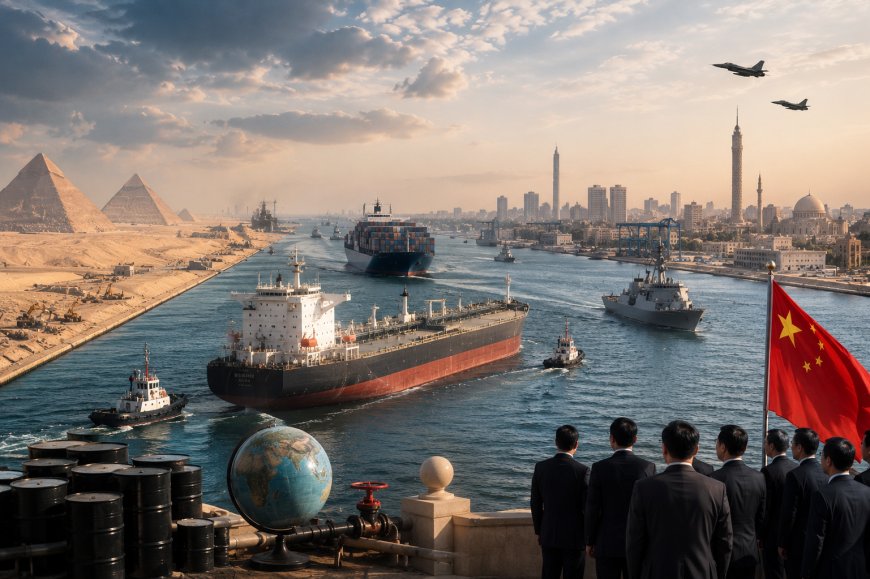
The Middle East is witnessing a major geopolitical shift. While the United States and Iran are once again locked in a military confrontation around the Strait of Hormuz, China is strengthening its strategic presence in Egypt.
Chinese President Xi Jinping’s visit to Egypt comes at a critical moment, as disruptions around Hormuz have raised concerns over global energy supplies and maritime trade.
At first glance, Xi’s visit is a diplomatic and economic engagement between China and Egypt. But strategically, it carries much greater significance because Egypt controls the Suez Canal, one of the world's most important trade routes.
Hormuz Crisis Raises the Importance of Suez
The Strait of Hormuz is a critical energy chokepoint through which a huge volume of global oil and gas shipments passes.
With military tensions between the US and Iran affecting shipping activity in the region, concerns are growing about possible disruptions to energy supplies and maritime trade.
According to Reuters, only four cargo vessels crossed the Strait of Hormuz on Tuesday, compared with an average of around 13 vessels per day over the previous 10 days.
Any prolonged disruption could increase the strategic importance of alternative maritime routes—including the Suez Canal.
Why Is the Suez Canal So Important?
The Suez Canal connects the Mediterranean Sea with the Red Sea, providing one of the fastest maritime links between Asia and Europe.
For China, the route is particularly important because the country is heavily dependent on international trade and global supply chains.
Egypt’s geographical position gives it influence over an important connection between Asia, Europe, Africa, and the Middle East.
This makes stronger ties with Cairo strategically valuable for Beijing.
China’s Growing Footprint in Egypt
China’s relationship with Egypt is no longer limited to trade.
Chinese companies have expanded their presence in areas including infrastructure, manufacturing, ports, renewable energy, and technology.
The two countries have also been strengthening defense cooperation. Recent military exercises involving Chinese and Egyptian aircraft have highlighted the growing security dimension of their relationship.
Egypt has traditionally been an important strategic partner of the United States, but Cairo has increasingly diversified its international relationships by engaging with China, Russia, and European powers as well.
China vs. the US: A New Middle East Equation?
For decades, the United States has maintained a powerful military and strategic presence across the Middle East.
China, however, has adopted a different approach—using trade, infrastructure investment, diplomacy, and economic partnerships to expand its influence.
Beijing’s role in helping restore diplomatic relations between Saudi Arabia and Iran in 2023 was an important example of China's growing diplomatic ambitions in the region.
The Egypt relationship adds another important piece to this strategy.
However, this does not necessarily mean that China is replacing the United States in the Middle East. Instead, regional countries appear increasingly interested in maintaining relationships with multiple global powers rather than depending entirely on one.
Why India Should Be Watching Closely
The changing situation is also highly significant for India.
Both the Strait of Hormuz and the Suez Canal are strategically important to India.
Hormuz is crucial for India's energy security because large volumes of oil and gas supplies pass through the region. Meanwhile, the Suez Canal is an important route for India's trade with European markets.
If Hormuz remains disrupted while Suez becomes increasingly important, changes in regional alliances could have implications for India's energy supplies, shipping costs, and international trade.
India will therefore need to carefully balance its relationships with the United States, Gulf countries, Egypt, and other major players in the region.
Is the Middle East Power Map Really Changing?
It may be too early to say that China has replaced the United States as the dominant power in the Middle East.
But the strategic landscape is clearly evolving.
The Hormuz crisis, the importance of the Suez Canal, and China's expanding relationship with Egypt represent three interconnected developments that could influence the region's future.
Xi Jinping's Egypt visit is therefore more than just a diplomatic trip. It highlights China's attempt to strengthen its position at the intersection of global trade, energy security, maritime routes, and Middle Eastern geopolitics.
What's Your Reaction?
 Like
0
Like
0
 Dislike
0
Dislike
0
 Love
0
Love
0
 Funny
0
Funny
0
 Angry
0
Angry
0
 Sad
0
Sad
0
 Wow
0
Wow
0