






























BIMSTEC Security Meet in Delhi: Ajit Doval Calls for United Action Against Emerging Regional Threats
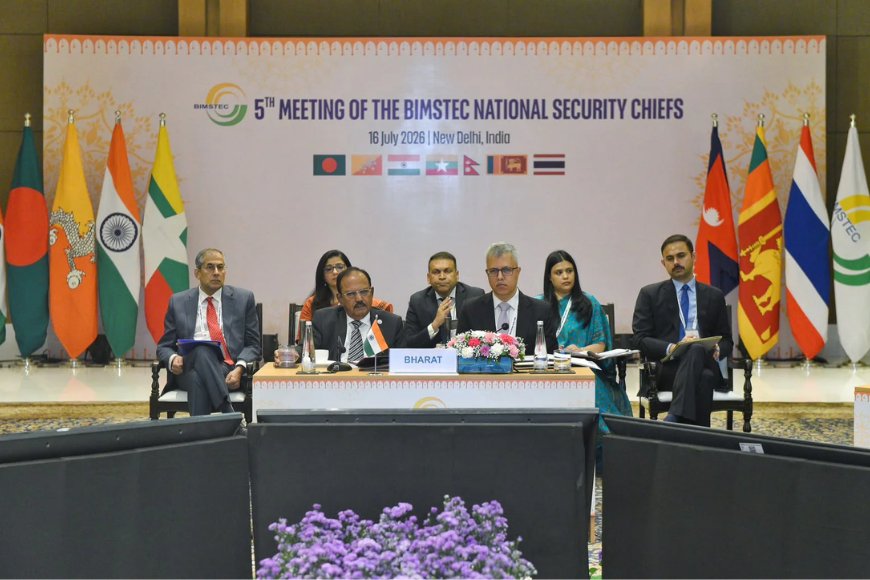
At the BIMSTEC National Security Advisers' Meeting in New Delhi, India's National Security Adviser Ajit Doval emphasized the need for stronger regional cooperation to tackle emerging security challenges, including terrorism, cyber threats, organized crime, and maritime security. He urged member nations to work together through intelligence sharing and coordinated action.

New Delhi became the center of regional security diplomacy as India hosted the BIMSTEC National Security Advisers (NSA) Meeting, bringing together senior security officials from the seven member countries of the Bay of Bengal Initiative for Multi-Sectoral Technical and Economic Cooperation (BIMSTEC). The high-level gathering focused on strengthening regional cooperation to address rapidly evolving security challenges that increasingly transcend national borders.
Addressing the meeting, India's National Security Adviser Ajit Doval stressed that the security landscape is undergoing profound changes due to geopolitical tensions, technological advancements, cyber threats, terrorism, and transnational organized crime. He urged BIMSTEC member nations to enhance cooperation, strengthen institutional mechanisms, and adopt coordinated strategies to safeguard regional peace and stability.
The meeting reflected India's continued efforts to position BIMSTEC as a key platform for regional security collaboration while reinforcing its broader foreign policy objectives under the Neighbourhood First and Act East policies.
A Platform for Regional Security Cooperation
BIMSTEC comprises seven member nations—Bangladesh, Bhutan, India, Myanmar, Nepal, Sri Lanka, and Thailand—representing a region that is home to nearly 1.8 billion people and plays a crucial role in global trade and maritime connectivity.
While BIMSTEC was initially established to promote economic and technical cooperation, security has emerged as one of its most significant areas of collaboration. The growing complexity of regional and global threats has prompted member states to work more closely on issues that affect collective peace and stability.
The NSA meeting in Delhi reaffirmed the organization's commitment to strengthening security partnerships among member countries.
Ajit Doval's Message: Collaboration is the Need of the Hour
During his address, Ajit Doval highlighted that today's security threats are more interconnected than ever before. Traditional military threats are now accompanied by cyberattacks, digital espionage, terrorism, organized crime, trafficking networks, and maritime security challenges.
He emphasized that no single nation can effectively tackle these challenges alone. Instead, countries must build stronger partnerships, improve intelligence sharing, coordinate law enforcement efforts, and develop joint mechanisms to respond quickly to emerging risks.
According to Doval, regional security cooperation should be based on trust, timely information exchange, and coordinated policy implementation.
Countering Terrorism Remains a Priority
One of the central themes of the meeting was counter-terrorism.
India has consistently advocated stronger international cooperation against terrorism and has repeatedly called for coordinated efforts to dismantle terrorist financing networks, prevent radicalization, and eliminate safe havens for extremist organizations.
The BIMSTEC member nations discussed ways to improve intelligence-sharing mechanisms, strengthen border security, and enhance cooperation between security agencies.
The meeting also examined the growing use of technology by terrorist organizations, including encrypted communication platforms, cyber tools, and online propaganda, highlighting the need for collective preparedness.
Cybersecurity Takes Center Stage
Cybersecurity emerged as another major topic during the discussions.
Governments across the world are facing increasingly sophisticated cyber threats targeting financial systems, government institutions, critical infrastructure, healthcare, transportation, and communication networks.
Ajit Doval stressed that digital security has become an integral part of national security. As economies become more digitally connected, cyber resilience must become a regional priority.
Participants explored opportunities for greater cooperation in cyber intelligence, digital infrastructure protection, cybercrime investigations, and capacity building.
Maritime Security in the Bay of Bengal
The Bay of Bengal remains one of the world's most strategically important maritime regions.
It serves as a critical route for international shipping, trade, energy transportation, and regional commerce. However, the region also faces challenges including piracy, illegal fishing, human trafficking, narcotics smuggling, and maritime terrorism.
The NSA meeting highlighted the importance of improving maritime domain awareness, strengthening naval cooperation, conducting joint exercises, and sharing maritime intelligence to ensure safe and secure sea lanes.
India reiterated its commitment to promoting a free, open, secure, and rules-based maritime environment in the Indo-Pacific region.
Strengthening India's Regional Diplomacy
Hosting the BIMSTEC NSA Meeting reinforces India's growing diplomatic engagement with its neighboring countries.
Over the past several years, New Delhi has actively promoted BIMSTEC as an important regional organization capable of addressing both economic and security challenges.
The meeting aligns with India's broader foreign policy strategy of strengthening regional connectivity, enhancing defense cooperation, and promoting sustainable development across the Bay of Bengal region.
By bringing together top security officials, India also demonstrated its willingness to play a leading role in fostering regional peace and stability.
Importance of Intelligence Sharing
A key takeaway from the meeting was the importance of real-time intelligence sharing.
Security experts widely agree that modern threats evolve rapidly, making timely information exchange essential for preventing attacks and responding effectively to crises.
Member nations discussed improving coordination among intelligence agencies, strengthening communication channels, and creating institutional frameworks that enable faster cooperation during emergencies.
Such collaboration is expected to enhance regional preparedness against both conventional and non-conventional security threats.
BIMSTEC's Expanding Strategic Role
The changing geopolitical environment has increased BIMSTEC's strategic importance.
With shifting global alliances, emerging technologies, and evolving security risks, regional organizations are playing a more significant role in maintaining stability.
BIMSTEC provides an important platform where neighboring countries can engage in constructive dialogue without the complexities associated with larger international organizations.
The Delhi meeting demonstrated the organization's growing relevance in shaping regional security architecture.
Looking Ahead
Experts believe that future BIMSTEC cooperation will likely expand beyond traditional security issues to include artificial intelligence governance, critical infrastructure protection, supply chain resilience, disaster management, and climate-related security risks.
As technology continues to reshape global security, collaborative approaches will become increasingly essential.
The NSA meeting laid the groundwork for deeper institutional cooperation that could benefit the entire Bay of Bengal region in the years ahead.
Conclusion
The BIMSTEC National Security Advisers' Meeting in New Delhi underscored the importance of regional unity in addressing today's increasingly complex security environment. Ajit Doval's call for stronger collaboration reflected India's broader vision of building a secure, stable, and resilient neighborhood through collective action.
With terrorism, cybercrime, maritime threats, and transnational crime becoming more sophisticated, BIMSTEC countries recognize that effective security can only be achieved through partnership, trust, intelligence sharing, and coordinated responses.
As regional cooperation continues to deepen, BIMSTEC is expected to play an increasingly important role in shaping the future security architecture of the Bay of Bengal region while strengthening peace, stability, and prosperity for its member nations.
What's Your Reaction?
Like
0
Dislike
0
Love
0
Funny
0
Angry
0
Sad
0
Wow
0