

















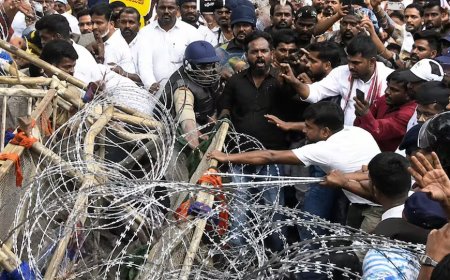

Farmers Stage Massive Protest in Bhopal: Sit-In at Savarkar Setu Escalates Tensions Ahead of CM House March
Thousands of farmers gathered in Bhopal, camping at Savarkar Setu as they intensified their protest over pending demands. With plans to march towards the Chief Minister’s residence, security has been tightened amid rising tensions between protesters and the administration.

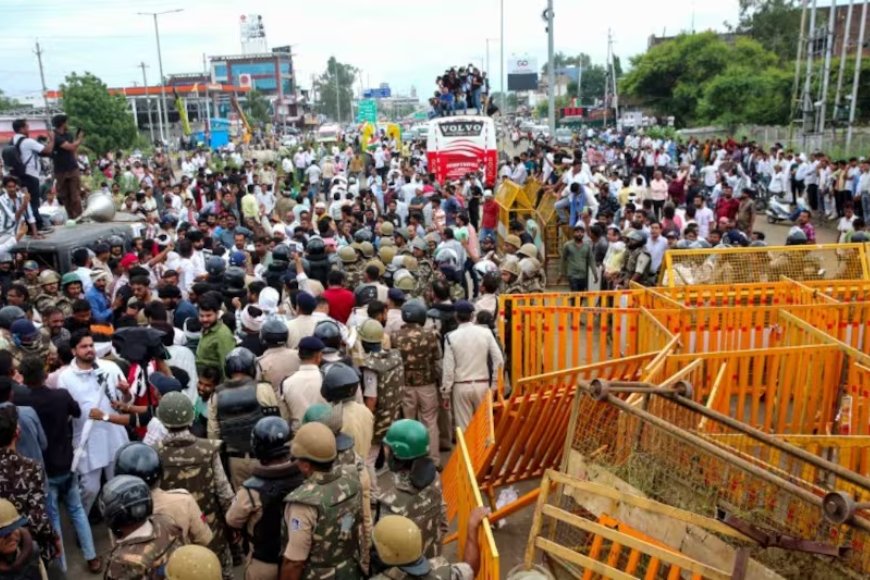
Bhopal witnessed a major show of strength by farmers as thousands assembled in the Madhya Pradesh capital, transforming the city into the centre of a high-profile protest. The demonstrators gathered at Savarkar Setu, where they staged a sit-in and announced plans to march towards the Chief Minister's residence, significantly raising tensions between farmer groups and the state administration.
The large-scale mobilisation prompted authorities to strengthen security across key parts of the city. Police personnel were deployed in significant numbers, barricades were erected on major routes, and traffic diversions were introduced to manage both the movement of protesters and the flow of vehicles. The administration remained on high alert, anticipating that the proposed march could lead to confrontation if protesters attempted to move beyond designated protest zones.
Farmers Rally Around Key Demands
Farmer organisations participating in the protest stated that the demonstration was aimed at drawing the government's attention to several long-pending agricultural issues. They alleged that repeated assurances from authorities had not translated into meaningful action on the ground.
Among the key concerns raised by protesters were demands for fair crop prices, timely procurement, settlement of pending compensation, irrigation improvements, crop insurance benefits, loan-related issues, and better financial support for cultivators affected by unpredictable weather conditions.
Farmer leaders argued that agriculture continues to face multiple challenges, including rising production costs, fluctuating market prices, and climate-related uncertainties. They maintained that stronger government intervention is necessary to safeguard rural livelihoods.
Savarkar Setu Becomes the Protest Hub
Savarkar Setu emerged as the focal point of the agitation, with hundreds of tractors, vehicles, and groups of farmers gathering from various districts of Madhya Pradesh.
Participants carried banners, raised slogans, and held meetings throughout the day while announcing their intention to continue the protest until concrete assurances were received from the government.
Temporary arrangements for food, drinking water, medical assistance, and resting areas were established by organisers to support protesters arriving from different parts of the state.
The atmosphere remained largely peaceful, although tensions increased as discussions about the planned march toward the Chief Minister's residence gained momentum.
Administration Tightens Security
The proposed CM House march prompted the state administration to implement extensive security arrangements across Bhopal.
Police installed multiple layers of barricades near sensitive government buildings and important intersections. Additional security personnel, rapid response teams, and senior police officers were deployed to monitor developments throughout the day.
Authorities appealed to protesters to maintain peace and avoid entering restricted areas. Officials also requested farmer leaders to cooperate with law enforcement agencies in preventing any disruption to public order.
Traffic movement was affected in several parts of the city due to road closures and diversions introduced as a precautionary measure.
Farmer Leaders Call for Dialogue
Representatives of the protesting organisations reiterated that their primary objective was to secure meaningful dialogue with the state government.
They stated that the planned march was intended to symbolically convey the seriousness of farmers' concerns rather than create confrontation. According to protest organisers, repeated memorandums and previous discussions had failed to produce satisfactory outcomes, prompting them to organise a larger mobilisation.
Farmer leaders expressed hope that direct engagement with senior government officials could help resolve outstanding issues through negotiation.
Government Responds
State government representatives acknowledged the concerns raised by farmers and indicated that officials remained open to discussions.
Authorities appealed to protesters to avoid actions that could disrupt essential public services or inconvenience city residents. Government officials also stressed that maintaining law and order remained a top priority while ensuring that peaceful democratic protests were respected.
The administration continued to monitor developments closely and maintained communication with farmer representatives to prevent escalation.
Impact on Daily Life
The large gathering significantly affected normal life in parts of Bhopal.
Traffic congestion was reported on several major roads leading toward the protest site, with commuters experiencing delays because of diversions and security checkpoints.
Public transport services were also affected in some areas, while businesses located near the protest venue witnessed reduced customer movement during the day.
Emergency services remained operational, with authorities ensuring that ambulances and essential vehicles could move through designated corridors despite road restrictions.
Wider Political Significance
The farmers' mobilisation has attracted considerable political attention as agricultural issues remain an important subject in Madhya Pradesh.
Political parties from both the ruling and opposition camps closely monitored the protest, with several leaders expressing support for farmers' concerns while urging peaceful resolution through dialogue.
Analysts noted that large farmer demonstrations often influence public debate on agricultural policies, rural welfare, procurement systems, and government support programmes.
The protest also highlights the continuing importance of agriculture in the state's economy, where a significant portion of the population depends directly or indirectly on farming.
Peaceful Protest Remains the Priority
Security officials repeatedly appealed for restraint from both protesters and law enforcement personnel.
Farmer organisations instructed participants to remain disciplined and avoid violence, emphasising that their objective was to communicate their demands democratically.
Police, meanwhile, maintained surveillance through drones, CCTV cameras, and field officers to quickly respond to any unexpected developments.
Authorities indicated that negotiations would continue if both sides remained committed to constructive dialogue.
What Happens Next?
The future course of the protest will largely depend on discussions between farmer representatives and the state government.
If negotiations produce positive outcomes, the demonstration may conclude peacefully. However, if major demands remain unresolved, farmer organisations have indicated they could intensify their agitation in the coming days through additional protests, rallies, or statewide mobilisation.
For now, Bhopal remains at the centre of a significant farmers' movement, with both protesters and authorities attempting to balance democratic expression with public order.
The coming days will be crucial in determining whether dialogue leads to a breakthrough or whether the ongoing agitation develops into a broader statewide campaign. As tensions remain high around the proposed CM House march, all eyes are on the government's response and the willingness of both sides to reach a peaceful resolution through negotiation rather than confrontation.
What's Your Reaction?
 Like
0
Like
0
 Dislike
0
Dislike
0
 Love
0
Love
0
 Funny
0
Funny
0
 Angry
0
Angry
0
 Sad
0
Sad
0
 Wow
0
Wow
0