































US Publishes Video of Precision Strikes on Iran as Washington Issues Stern Warning to Tehran
The United States has released a 37-second video showing precision airstrikes on Iranian military targets, saying the operation was carried out in response to an alleged Iranian attack on commercial shipping. The footage was accompanied by a strong warning that any future aggression would be met with decisive military action.

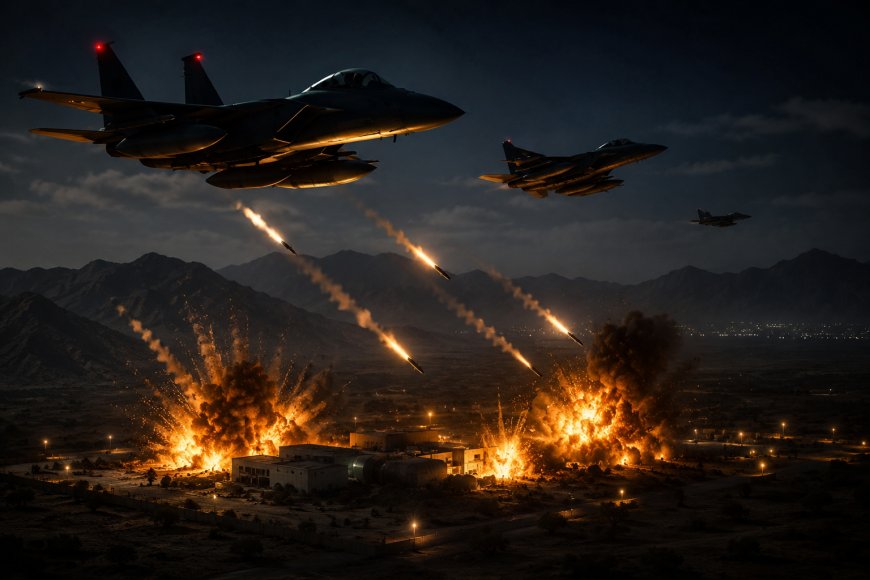
Washington, D.C.: The United States has released dramatic 37-second footage of precision military strikes targeting Iranian military infrastructure, marking another significant escalation in tensions between Washington and Tehran. The video, released by the US Central Command (CENTCOM), shows multiple guided strikes hitting what American officials described as Iranian missile storage facilities, drone launch sites, and radar installations.
The release of the footage comes just days after the United States accused Iran of carrying out a drone attack on a commercial cargo vessel transiting the strategically important Strait of Hormuz. According to US officials, the military operation was a direct response aimed at deterring further attacks on international shipping and protecting maritime security in one of the world's busiest trade routes.
The short video captures aerial surveillance footage followed by precision-guided munitions striking multiple targets. While the footage does not reveal the exact locations of the installations, US defence officials stated that the sites were selected based on intelligence linking them to recent attacks on commercial maritime traffic.
Shortly after releasing the footage, senior US leaders reiterated Washington's position that attacks on American interests or international shipping would not go unanswered. US Vice President JD Vance issued a strong warning, declaring that "violence will be met with violence," emphasizing that while the United States seeks stability in the Middle East, it remains fully prepared to defend its personnel, allies, and global trade routes.
The latest military action follows an alleged Iranian drone strike on a Singapore-flagged cargo ship navigating through the Strait of Hormuz. US officials claimed the attack violated an existing ceasefire understanding and represented a serious threat to freedom of navigation in international waters.
According to the Pentagon, the retaliatory operation specifically targeted military infrastructure believed to have supported the alleged drone attack. Defence officials stressed that the strikes were carefully planned to avoid civilian casualties while sending a clear deterrent message to Iran.
The Strait of Hormuz remains one of the most strategically significant waterways in the world. Nearly one-fifth of global crude oil exports and a substantial portion of liquefied natural gas shipments pass through the narrow maritime corridor connecting the Persian Gulf to international markets. Any disruption in the region has the potential to impact global energy prices, shipping insurance costs, and international supply chains.
US Central Command stated that American naval and air assets continue to monitor maritime activity throughout the Gulf region to ensure the safe passage of commercial vessels. Officials also reaffirmed their commitment to working alongside international partners to maintain regional stability and safeguard global commerce.
Iran, however, has strongly condemned the US strikes, accusing Washington of violating international law and escalating tensions unnecessarily. Iranian authorities denied responsibility for the alleged attack on the cargo vessel and warned that further military action by the United States could trigger a proportionate response.
Officials linked to Iran's Revolutionary Guard stated that the country reserves the right to defend its sovereignty and national security. While Iranian leaders have not officially announced retaliatory military measures, their statements have heightened concerns about the possibility of another round of military exchanges.
The renewed confrontation has once again placed the Middle East on high alert. Although both Washington and Tehran have publicly indicated that they do not seek a full-scale conflict, analysts warn that repeated military encounters significantly increase the risk of unintended escalation.
Security experts note that the release of combat footage has become an increasingly common strategic communication tool. Governments often publish videos of military operations to demonstrate operational capability, reassure allies, shape international narratives, and deter future attacks.
The 37-second video released by CENTCOM appears designed not only to showcase the precision of the operation but also to reinforce Washington's message that attacks on commercial shipping or US interests will receive an immediate and forceful response.
International reactions have largely focused on the need for restraint. Several governments have urged both countries to avoid actions that could destabilize the Gulf region further. Diplomatic observers have emphasized that preserving freedom of navigation through the Strait of Hormuz remains essential for global economic stability.
The latest developments have also renewed concerns in global financial markets. Historically, heightened tensions in the Gulf have contributed to fluctuations in crude oil prices due to fears of potential supply disruptions. Energy analysts continue to closely monitor the situation for any signs of further military escalation.
Defence analysts believe the operation reflects Washington's broader strategy of maintaining deterrence without triggering a wider regional conflict. By limiting the strikes to military installations directly linked to the alleged attack, the United States appears to be balancing military retaliation with efforts to avoid an all-out confrontation.
Meanwhile, diplomatic channels remain active behind the scenes. Regional allies and international organizations continue encouraging dialogue between Washington and Tehran to prevent further deterioration of the security situation.
The incident also highlights the growing importance of maritime security in the Middle East. Commercial shipping routes through the Gulf remain vital to international trade, making their protection a strategic priority for the United States, its allies, and regional partners.
As tensions continue to simmer, military forces on both sides remain on heightened alert. Analysts warn that even a limited confrontation involving naval assets, drones, or missile systems could quickly escalate if communication channels fail.
For now, the release of the 37-second strike footage serves as both a demonstration of American military capability and a political message aimed at deterring future attacks. Whether the operation succeeds in preventing further confrontation or contributes to renewed escalation will depend largely on developments in the coming days and the willingness of both sides to pursue diplomatic solutions alongside military preparedness.
What's Your Reaction?
 Like
0
Like
0
 Dislike
0
Dislike
0
 Love
0
Love
0
 Funny
0
Funny
0
 Angry
0
Angry
0
 Sad
0
Sad
0
 Wow
0
Wow
0